
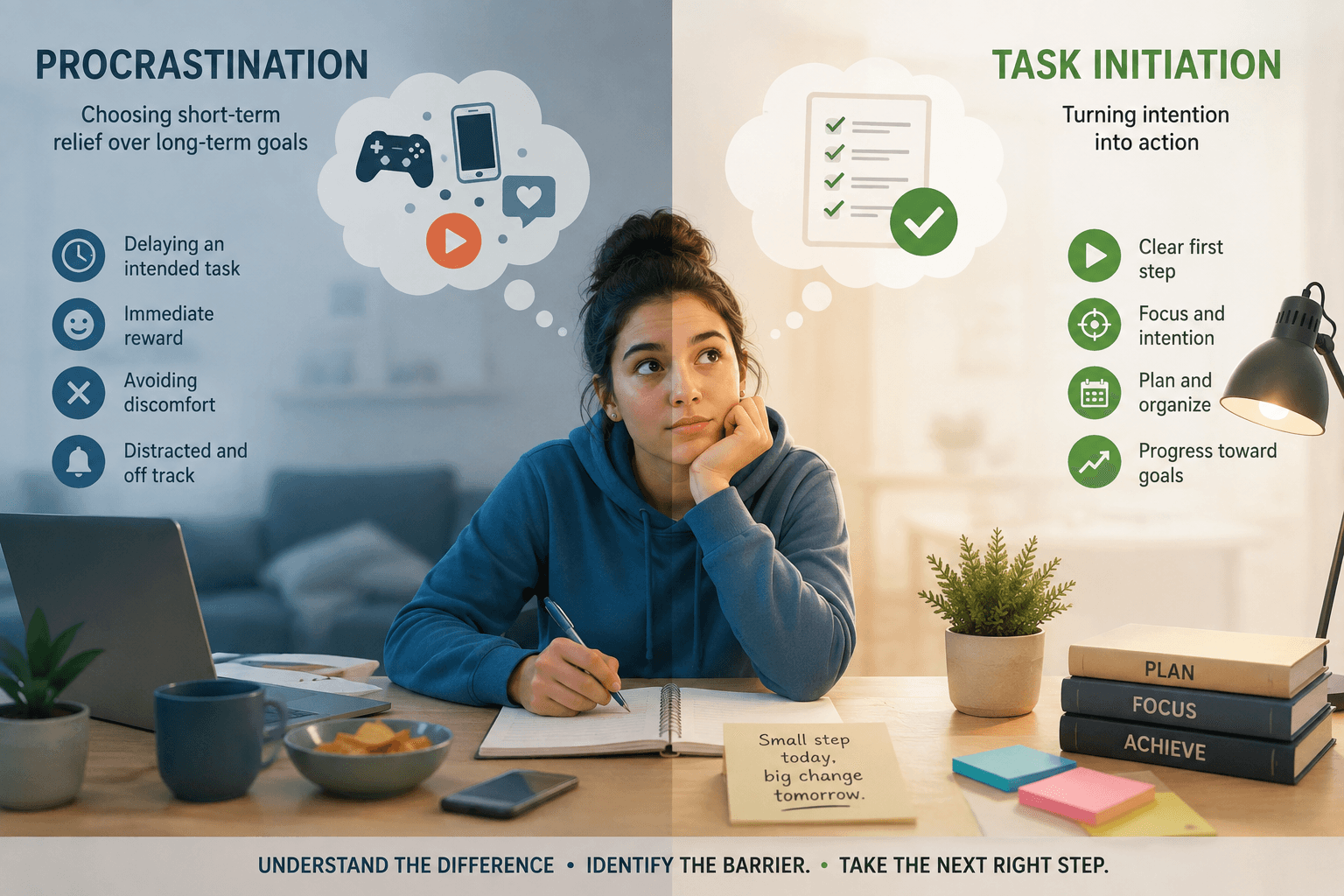
Executive Function: Procrastination Versus Task Initiation
“Why don’t you just start?”
I asked myself this question the last week. These last two weeks were really difficult! Too many things with due dates. Unfortunately, writing my blog is very enjoyable but other tasks took priority until today.
For individuals who struggle with executive functioning, this seemingly simple question can overlook an important distinction. Procrastination and difficulty initiating a task can look similar but may involve different underlying processes. Understanding the difference helps clinicians, educators, students, and individuals move beyond judging delayed behavior and instead identify what is preventing action.
Procrastination: Delaying an Intended Task
Procrastination generally involves putting off something that needs to be done, often despite knowing that delaying it may create problems later. The key issue is the gap between what a person intends to do and what they actually do. For example, a student may have sufficient time to complete an assignment but repeatedly choose social media, gaming, television, or another immediately rewarding activity instead.
Procrastination can be influenced by immediate rewards, task unpleasantness, competing activities, difficulty regulating attention or behavior, and emotional discomfort. It is, therefore, not necessarily a simple time-management problem. Motivation, self-regulation, emotions, and perceptions of the task can all influence behavior.
Task Initiation: Moving From Intention to Action
Task initiation is the ability to begin a planned or necessary activity—the transition from thinking about an action to taking the first step. A person experiencing initiation difficulty may know what needs to be done and genuinely want to complete it but still be unable to begin: “I know I need to start my paper. I have everything I need, but I cannot seem to begin.”
From the outside, this may look like procrastination. Internally, however, the person may be thinking about the task, becoming frustrated, and still unable to determine how to start. The difficulty occurs at the point where an intention must become an observable action.
The Critical Question: What Is Preventing Action?
A useful way to understand delayed behavior is to ask: Is the individual choosing not to begin, having difficulty beginning, or experiencing both?
Procrastination
Task-Initiation Difficulty
Delaying an intended task
Difficulty converting intention into action
Choosing another activity instead
Difficulty identifying or executing the first step
Preference for an immediate reward
Task feels too large, complex, or ambiguous
Avoiding an unpleasant task or emotion
High cognitive demands required to get started
Difficulty regulating behavior
Difficulty with initiation, planning, or organization
These categories are not mutually exclusive. An overwhelming assignment may initially create difficulty with initiation. After repeated unsuccessful attempts to begin, the individual may increasingly avoid it. What begins as an initiation problem can, therefore, develop into behavior that appears to be procrastination.
Why Starting Can Be Difficult
Starting a task often requires more executive functioning than the instruction suggests. Consider “Study for the exam.” The student must determine what to study, locate materials, decide where to begin, select a strategy, estimate the time required, and maintain attention once the process starts. For someone experiencing executive-function difficulties, these decisions can create a barrier before the actual work begins.
Making the first action more concrete can reduce that barrier. For example:
- “Study for the exam” → Open the notes and review pages 1–3.
- “Complete the report” → Open the document and write the title.
- “Clean the house” → Put the dishes in the dishwasher.
Breaking a task down does not eliminate the work; it reduces the distance between intention and action.
Emotion and Task Avoidance
Emotions can also affect whether a person begins. A difficult task may create boredom, frustration, anxiety, uncertainty, embarrassment, or fear of failure. Avoiding the task can temporarily reduce those uncomfortable feelings, creating a cycle of task discomfort → avoidance → short-term relief → continued delay.
Although avoidance may provide immediate relief, the unfinished task remains and may become more stressful later. Consequently, telling someone to “just do it” may have limited effectiveness. The individual may need to address both the task itself and the emotional response associated with beginning it.
Matching the Strategy to the Problem
Different barriers may require different strategies.
When procrastination is prominent, consider:
- What makes the task undesirable or uncomfortable?
- What immediately rewarding alternatives are available?
- Is the person avoiding a particular emotion?
- How do immediate and delayed consequences influence behavior?
- How do distractions affect follow-through?
When task initiation is the primary barrier, consider:
- Defining the smallest possible first action.
- Breaking large tasks into observable steps.
- Preparing materials before the starting time.
- Using visual cues and external reminders.
- Establishing a specific time and location for beginning.
- Reducing unnecessary decisions before starting.
- Using a brief “starter” period rather than focusing on completing the entire task.
A More Useful Question
The goal is not simply to make someone start. The goal is to identify what is preventing the transition from intention to action. Rather than asking, “Why are you procrastinating?” consider asking:
“What happens between knowing you need to do something and actually beginning it?”
The answer may reveal avoidance, emotional discomfort, competing rewards, unclear expectations, organization, planning, task complexity, initiation difficulties, or several factors operating together.
Conclusion
Procrastination and task-initiation difficulty are related, but delayed action should not automatically be interpreted as procrastination. A person may postpone a task because another activity is more immediately rewarding, because the task produces uncomfortable emotions, or because regulating attention and behavior is difficult. Another person may genuinely intend to begin but become stuck when attempting to translate that intention into a first action.
The distinction is best understood as a question of mechanism rather than a rigid either-or classification. Instead of asking, “Why won't you do it?” a more useful question is:
“What specific process is getting in the way of starting?”
Identifying that process provides a stronger foundation for selecting an appropriate strategy and supporting successful, goal-directed behavior.
For assistance with executive-function difficulties, contact Pillars of Wellness to speak with a therapist and develop an effective plan.