Athletes spend countless hours training their bodies through building strength, speed, endurance, and technical skill. But performance isn’t just physical. The way athletes think in moments of pressure, mistakes, and uncertainty often determines whether they tighten up or rise to the occasion. Thoughts, feelings, and beliefs can significantly impact how an athlete responds under pressure, recovers from setbacks, and ultimately performs. This is where a powerful tool called Rational Emotive Behavior Therapy (REBT) comes into play, offering a practical way to build mental resilience and unlock an athlete's full potential.
REBT Explained: It's All About Your Beliefs
So, what exactly is REBT? Developed by Dr. Albert Ellis, REBT is a type of therapy that helps us understand how our thoughts, feelings, and actions are deeply connected. The core principle of REBT explains that it's not the events themselves that directly cause emotional distress, but rather one's beliefs about those events.
In sport, athletes often assume that external events drive their emotions. Imagine a scenario: you miss a crucial shot in a game. The activating event is missing the shot. If your belief about this event is, "I'm a terrible player, I always mess up," you might feel intense frustration, anger, or despair (the consequence).
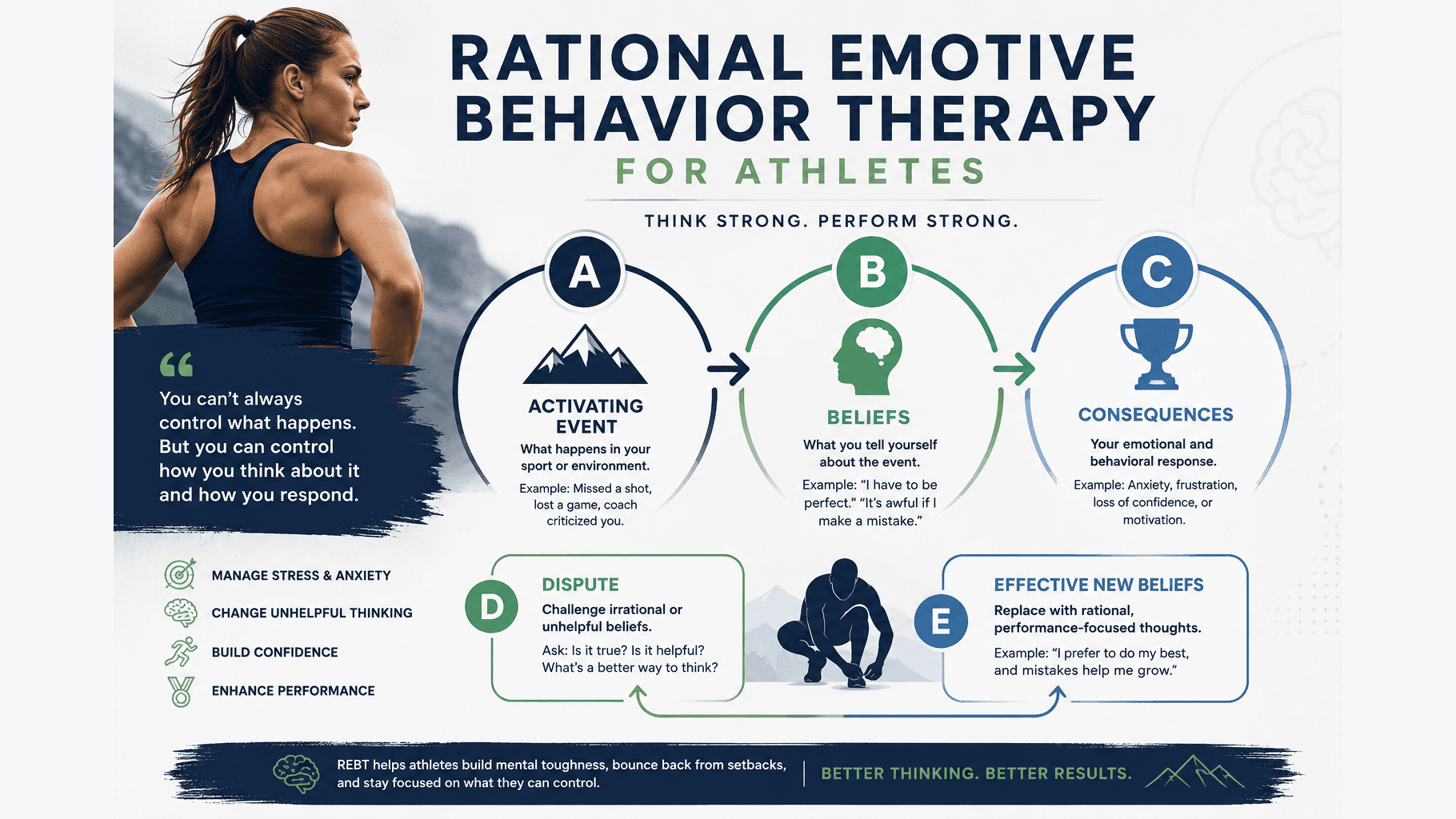
REBT shifts this understanding. It proposes that the sequence looks like this:
A – Activating Event: what happens (e.g., making a mistake)
B – Beliefs: what you tell yourself about it
C – Consequences: how you feel and respond
However, if your belief is, "I missed that one, but I'm capable and will learn from it and focus on the next play," your emotional consequence will be much more constructive, perhaps disappointment but followed by renewed determination.
The key driver is B-beliefs.
REBT helps us identify and challenge these unhelpful, often irrational, beliefs (what we call "cognitive distortions") and replace them with more rational, empowering ones. It's about learning to respond to life's challenges with resilience, not being overwhelmed by them.
The “Must” Trap in Athletes
A major focus in REBT is identifying rigid thinking patterns, especially the word “must.”
Athletes often unknowingly operate under internal rules like:
- “I HAVE to win.”
- “I can’t make mistakes.”
- “I should always be PR (be improving).”
- “If I fail, it means something is wrong with me.”
These beliefs feel motivating, but they tend to increase pressure, anxiety, and emotional volatility. When everything becomes a “must,” the brain interprets sport as a threat instead of a challenge.
A more effective mindset replaces rigidity with flexibility:
- “I want to perform well, but I don’t have to be perfect.”
- “I prefer to succeed, but I can handle setbacks.”
- “I’m not always going to PR, but I will try my best”
This shift reduces pressure and improves decision-making under stress.
Not All Negative Emotions Hurt Performance
REBT also helps athletes distinguish between helpful and unhelpful emotional responses.
Not all “negative” emotions are bad. In fact, some are essential for sport:
- Concern helps focus attention
- Disappointment allows learning
- Frustration can fuel adjustment
The problem arises when emotions become extreme:
- Anxiety that overwhelms focus
- Shame that leads to withdrawal
- Frustration that disrupts control
The goal is not to eliminate emotions, but to develop a better understanding, response, and relationship to them.
Unconditional Self-Acceptance: The Deeper Shift
A central idea in REBT is Unconditional Self-Acceptance (USA). This means recognizing that your worth is not determined by your performance.
You can:
- Have a bad race and still be valuable
- Make mistakes and still be enough
- Lose a competition and still be worthy
This doesn’t lower standards. It removes identity from outcome.
When athletes are no longer trying to “prove themselves” every time they compete, they often become more consistent, more confident, and more willing to take the risks needed to improve.
How REBT Helps Athletes Conquer Challenges
For athletes, the pressure can be immense. REBT offers a framework to navigate common performance hurdles:
- Dealing with Mistakes: Every athlete makes errors. REBT helps you avoid catastrophizing a mistake ("This proves I'm not good enough") and instead view it as a learning opportunity ("What can I adjust for next time?").
- Performance Anxiety: Before a big competition, it's easy to get caught up in worries like, "What if I fail?" or "Everyone is expecting me to win." REBT helps dispute these worries, replacing them with a focus on preparation and present-moment performance.
- Injury Recovery: An injury can be incredibly frustrating. REBT assists athletes in managing negative thoughts about recovery time or future performance, fostering a more positive and proactive mindset during rehabilitation.
- Handling Tough Opponents: Instead of seeing a strong opponent as a threat to your self-worth, REBT can help you view them as a challenge that pushes you to improve and perform at your best.
- Managing Coach/Parental Pressure: It can be hard to separate external expectations from your own goals. REBT provides tools to process feedback constructively and maintain your self-belief, even when others' expectations feel overwhelming.
Your REBT Playbook: Practical Strategies for Mental Toughness
Ready to put REBT into action? Here are some practical steps:
- Listen to your self-talk. Identify the "ABC"s: Become aware of the stories you're telling yourself, especially after mistakes, losses, or critical feedback. When you experience a strong, unhelpful emotion (like extreme anger, despair, or anxiety) related to your sport, try to break it down:
** A (Activating Event):** What happened? (e.g., missed a shot, lost a game, got criticized).
B (Belief): What thoughts or beliefs did you have about that event? (e.g., "I'm a failure," "This is unfair," "I should never make mistakes").
C (Consequence): What were the emotional and behavioral results? (e.g., extreme anger, giving up, yelling at teammates).
- Challenge Your Beliefs-Question your "musts" and "shoulds" (Dispute - D): Once you've identified an unhelpful belief, question it:
- Is this belief truly logical? Is there solid evidence for it?
- Is it helping me achieve my goals? Or is it hindering me?
- What's a more rational, helpful way to think about this situation?
- For example, instead of "I'm a failure," try, "I made a mistake, which is part of learning and growth. What can I do better next time?"
- When you feel overwhelmed, frustrated, or angry, ask yourself: "What demand am I putting on myself, others, or the situation? Is it truly rational?"
- Adopt New, Effective Beliefs (Effect - E): Actively replace rigid thoughts with flexible ones. Practice this new, rational belief until it becomes more automatic. The goal isn't to ignore reality or pretend everything is perfect, but to respond to reality in a way that serves your performance and well-being. For example:
- “It would be great to win, but it’s not the end of the world if I don’t.”
- “I don’t like getting criticized, but I can handle it and learn from it.”
- Focus on Effort, Not Just Outcome: Remind yourself that your worth as a person isn’t determined by a score or a win, but by your effort, growth, and character.
Support from the Sidelines: For Coaches and Parents
If you're a coach or parent, you play a vital role in an athlete's mental development. Here's how you can incorporate REBT principles:
- Model Rational Thinking: Show, don't just tell. When discussing performance, focus on effort, process, and learning, rather than solely on outcomes. "That was a tough game, but what did you learn from it?" is more helpful than "Why did you make that mistake?"
- Encourage Self-Reflection: Ask open-ended questions that help athletes identify their own beliefs. "What were you thinking after that play?" or "What thoughts tend to hold you back?"
- Help Them Dispute Irrational Beliefs: Guide them in challenging their own unhelpful thoughts without being dismissive. "Do you always mess up, or was that just one instance?" or "How does thinking that way help you right now?"
- Focus on Controllables: Help athletes distinguish between what they can control (effort, attitude, preparation) and what they cannot (opponent's performance, referee calls, weather).
Your Mind, Your Greatest Asset
REBT isn't about eliminating all negative emotions; it's about transforming unhealthy, self-defeating emotions into healthier, more manageable ones. By consciously working on your beliefs, you can develop a powerful mental toolkit that supports your physical training, helps you overcome obstacles, and ultimately leads to more consistent and enjoyable performance. Your mind is your greatest asset in sports – learn to train it just as diligently as you train your body.